A full inventory of the resource library, clear rules for what to gate, and three form tiers matched to intent, replacing one long form for everything.
The problem
By 2021, purestorage.com had a large library of downloadable content and no consistent rule for what to put behind a form. Every gated asset used the same long form, so a visitor early in their research faced the same questions as a buyer close to a decision.
The approach
The work ran in three stages: discovery, analysis, and execution.
- Inventory everything. Every downloadable asset was categorized by type, buyer's journey stage, and persona, which showed where gating was helping and where it was missing.
- Decide what to gate by asset type. In-depth research, such as analyst reports, eBooks, and white papers, would always carry a gate. Evaluation material, such as datasheets and solution briefs, stayed open.
- Match the form to the visitor's intent. Three form tiers replaced the single form, each asking only for what that stage justified.
- Roll out by funnel stage. Top of funnel launched first, then middle. Along the way, duplicate pages were consolidated, aged assets were retired, and selected open assets were moved behind the new forms.
- Test the details. Through the site's A/B testing program, changing the gated-form button from “Submit” to “Download now” lifted form submissions 19%.
Top of funnel
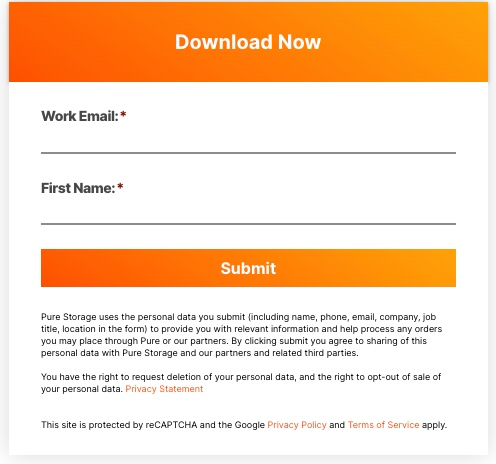
Minimum viable reveal
Work email and first name. Nothing else.
Middle of funnel
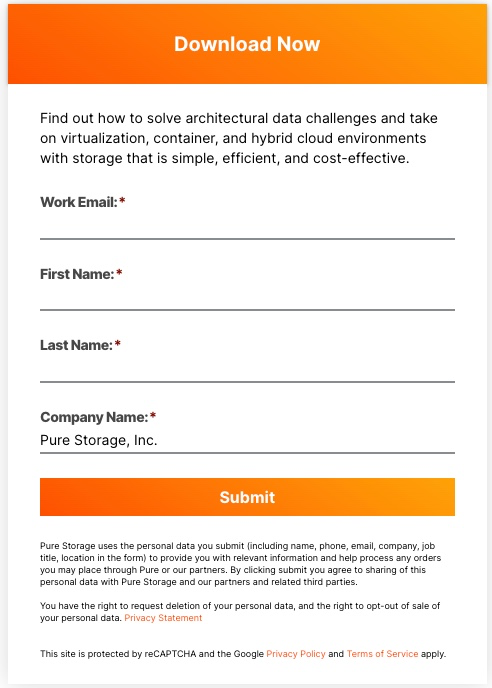
Progressive profile
Name, email, and company on a first visit. Returning visitors see only the fields still missing.
Bottom of funnel
Self-qualified profile
The qualifying questions Sales would ask, so high-intent leads arrive flagged.
My role
I initiated and led the asset gating initiative: the inventory, the gating framework, the form tiers, and the phased rollout. I partnered with marketing operations to build the forms, with web development on implementation, and with content and product marketing on which assets to gate, consolidate, or retire. I co-established the site's A/B testing program with the web development lead.
The result
From about 2.5% to 30%Conversion on top-of-funnel gated content, December 2021 to May 2022.
- Middle-of-funnel progressive forms converted at 26.5% over the same period.